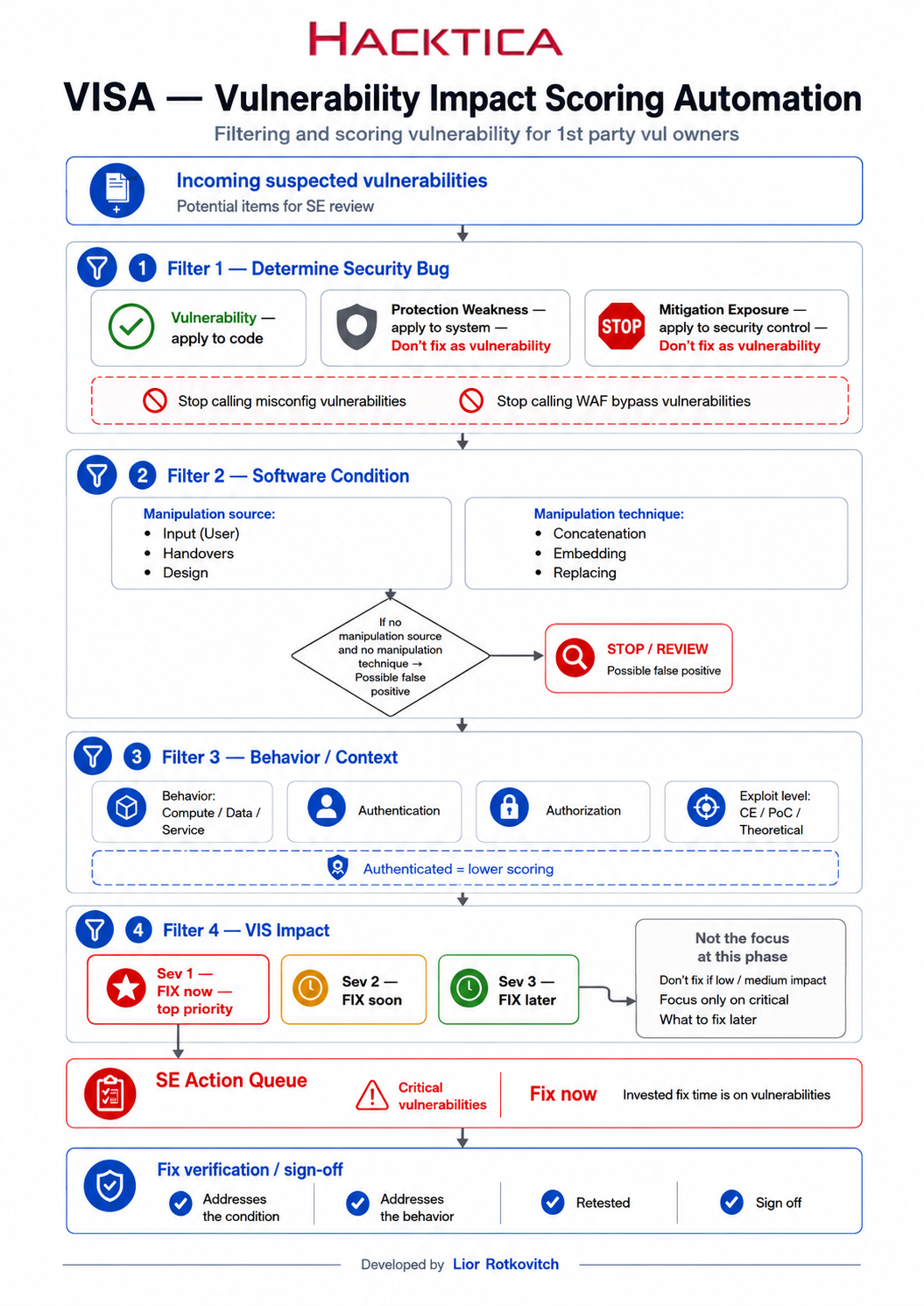
VISA — Vulnerability Impact Scoring Automation
Goal
The goal is to determine: impact based scoring
- Is it a vulnerability?
Invested fix time is spent on vulnerabilities, not on other security bugs that are excluded. - Is the impact critical?
Determine the impact. - Is it fixed?
Sign-off confirms: I understand and approve the classification, the impact, and what was fixed.
Filtering and Scoring Vulnerabilities for First-Party Vulnerability Owners
1. Find a Suspected Vulnerability
A suspected vulnerability is found.
2. Determine the Security Bug Type
Vulnerability
Applies to code.
Protection Weakness
Applies to the system.
Do not fix it as a vulnerability.
Mitigation Exposure
Applies to the security control.
Do not fix it as a vulnerability.
3. Software Condition Classification
Manipulation Source — Cause
Input — User
No sanitation or limits.
Examples:
- SQL injection
- XSS
- OS injection
Handovers
No sanitation between components or systems.
Examples:
- Log4j
- Directory traversal
Design
The login or design flow is wrong and can be bypassed.
4. Manipulation Technique
Concatenation
Appending malicious logic to existing code.
Embedding
Breaking parsing logic using a malformed structure.
Replacing
Substituting safe values with executable ones or replacing what is expected.
Examples:
- Replacing tokens
- Overriding due to configuration
- Replacing the design flow
5. Verify That It Is Not a False Positive
Verify whether the following exist:
- A manipulation source
- A manipulation technique
If they do not exist, it is a possible false positive.
6. Software Behavior Classification
Classify the exploitation behavior that violates CIA.
Compute
- Read configurations
- Tamper
- Install
- Code execution
Data
CRUD actions on data types:
- System
- Service
- PII
Service
- Load
- Random outage
- Service down
Determine the impact that the bug allows.
7. Authentication and Authorization Context
Authorization
Determine the context and level of execution.
Authentication
Determine whether the attacker needs to be logged in.
- CE
- RCE
8. Determine the Exploit Level
CE
Fully exploitable and weaponized.
- Condition
- Behavior
PoC
Partly or minimally exploitable and weaponized.
Theoretical
A bug condition exists, but the behavior cannot be proven.
It is not a vulnerability, but we do not take risks, so it is treated as a vulnerability.
9. Determine the Impact Using VIS
Determine the vulnerability impact based on Vulnerability Impact Scoring.
10. Determine the Severity Level
Severity 1
Fix now.
- Top priority
- Potential Crisis Response
Severity 2
Fix soon.
- Potential Emergency Response
Severity 3
Fix later.
- Potential Incident Response
11. Fix Verification and Sign-Off Sanity Check
The vendor Security Engineer owns the vulnerability and signs off on the fix.
Verify that the fix addresses the condition—the manipulation—and not only the observed behavior.
Fix Verification
- The fix addresses the condition and the behavior.
- The fix addresses only the behavior—risk of F4F.
- The manipulation technique no longer works after the fix.
- The vulnerability is retested at the same exploit level as originally proven.
- A minimum smoke test is performed.
Sign-Off
SE / PSIRT: ____________________
The sign-off confirms:
- It is a vulnerability.
- The scoring is correct.
- It is fixed.
- It is ready to publish.
12. If It Cannot Be Fixed
Use a compensating approach.
13. Publish
Publish the vulnerability using the:
Vulnerability Publication Impact Table
Publication method:
- Public disclosure
download – claude version hacktica-visa-process-flow