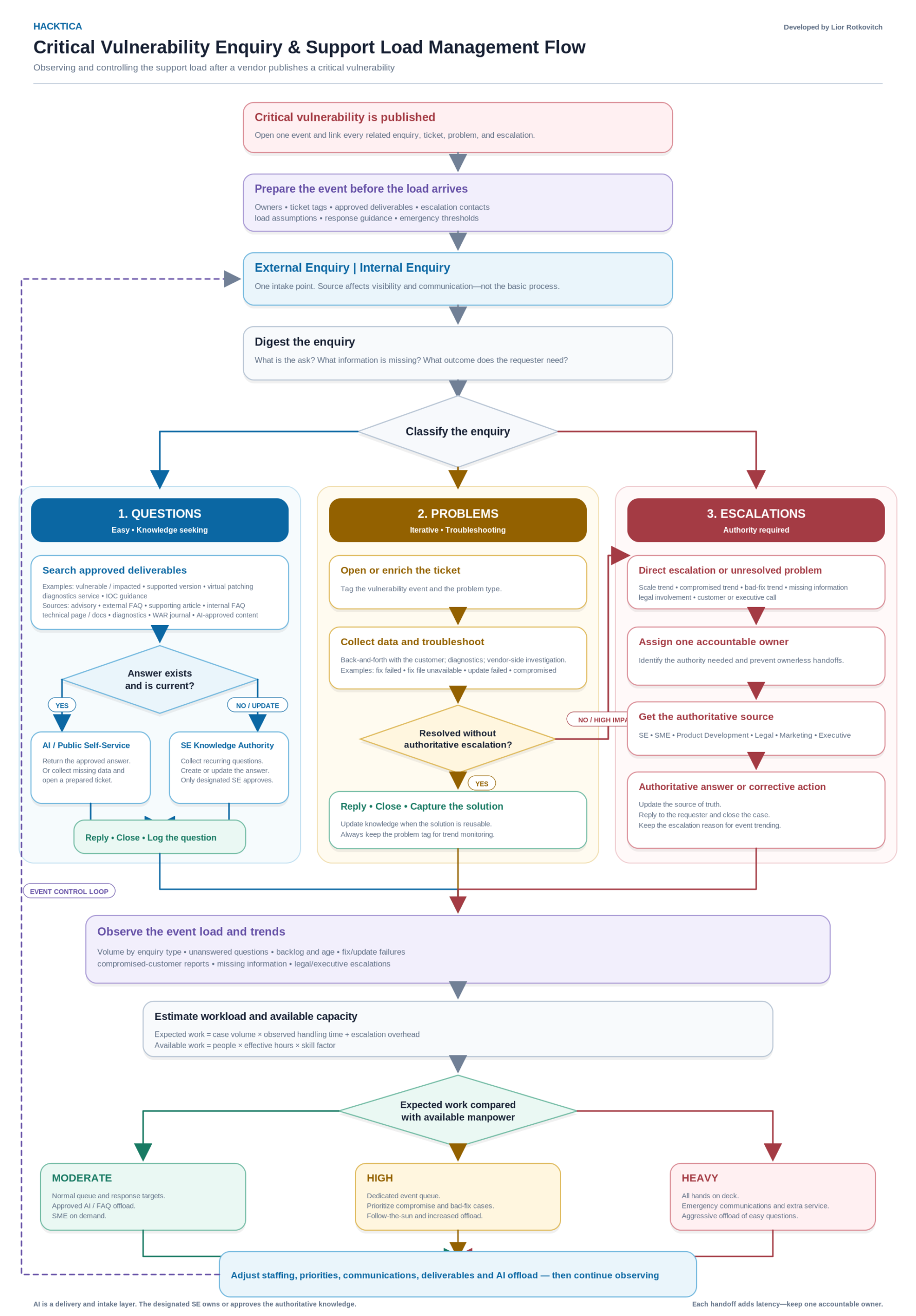
Enquiry Source
- External enquiry
- Internal enquiry
Enquiry Types
1. Questions — Knowledge Seeking
- Am I vulnerable? Am I impacted?
- Am I on a supported version?
- Is there virtual patching?
- Is there a diagnostics service?
- I see an IOC—what do I do?
2. Problems — Troubleshooting
- Fix failed
- Cannot get the fix file
- Customer was compromised
- Failed to update
3. Escalations
- Trending — scale
- Trending — compromised customers
- Trending — bad fix, F4F
- Too many customers asking about the same issue
- Too many customers have the same problem
- Missing information
- Need more information
- Legal involvement
- Customer calls
- Executive calls
- Authoritative answer
- Legal, marketing, technical, and framing
Enquiry Difficulty
- Easy — questions
- Iterative — problems requiring back-and-forth with the customer or investigation by the vendor
- Escalated — requires authoritative sources or Product Development
Digesting the Enquiry
- Language
- What is the ask?
- Guide them
- Make choosable options
Answer Type
- Internal
- External
- Public
Knowledge Base Flow
- Does a KB item exist?
- No
- Yes — public — offload
- Existing and solved
- Existing — requires an update
- New
- Escalation
- Approval by SE
- Update KB: internal, external, or public
- Authoritative answer
- Reply
- Legal, marketing, or technical escalation
Deliverables
- Advisory — main
- External FAQ
- Supporting articles
- Internal FAQ — what to say and what not to say
- Page or documentation — technical details
- WAR journal — trending
- Diagnostics
- Bot or agent — predefined questions
Ticketing
- Three tickets — Tier 1, Tier 2, and Tier 3
- Two tickets — Tier 1 and Tier 2, then Tier 3
- One ticket — sections and status or phase for Tier 1, Tier 2, and Tier 3
Resolution Time
- Response — 1, 4, or 8 working days
Stalling
- No response from the customer
- Missing information from the customer
- Missing internal information
- Escalation needed
Management and Assignment
- Manager supervision by engineer level
- Junior — focus on easy cases
- Senior — focus on complex cases
- SME — used on demand
- Manager verifies that there is no stalling
- Easy cases remain dedicated until reply
- Iterative cases are assigned by round robin or engineer level
Capacity Planning
- Number of customers or install base — X
- Number of active support cases — Y
- No-response estimate — 10% of X
- Expected load versus manpower
- Positive or negative capacity
- Emergency plan
- Offload
Manpower
- How many people can perform how much work?
- Junior — 1×
- Senior — 2×
- Senior — up to 2.5×
- SME — 1× to 2.5×
- Harder problems go to senior engineers
- Easy case time — 30 minutes
- Escalation adds two hours
- Escalation takes more time, but a senior SE performs at 2×
- Expected number of escalations
- Quality of the KBs
Anticipated Load
- Moderate — expected load or lower
- High — still working but busy; work through the queue
- Heavy — all hands on deck; grab and do
Working Coverage
- Full follow-the-sun
- Region-specific follow-the-sun to obtain most of the workforce
- Standard working hours
Preparing for Load
- Longer SLA
- All hands on deck
- Extra services
- Third-party communication services
- Chats
- Bots
- Bot conversations are shorter than tickets
- Pick-up-the-phone style
- AI utilization as the source of truth
Offload
- Offload by process
- “Please read this”
- Clear answers and questions
- Identify the missing part
- Offload by automation
- Provide the required information
Service Levels
- Self-diagnostics
- Full self-service — determine which KB source it belongs to
- Semi self-service — ticket
- Full ticket
Resource Distinctions
- Expert versus novice
- SME versus generalist
- Authorized versus unauthorized
Latency
- Every hop adds latency.
The entire set of considerations can therefore be reduced to:
- What enquiries are coming in?
- Where does the approved answer exist?
- How should each case be handled?
- What trends are appearing across all cases?
- How much work can the available people perform?
- What actions are required for Moderate, High, or Heavy load?